Alla Reminiscenza
On the music of Medtner and Rachmaninov, and a kind of memory
companion liner notes to the album, Alla Reminiscenza | est. read time: 10-15 min, ~2000 words
Introduction
The Forgotten Melodies of Nikolai Medtner and the Études-Tableaux of Sergei Rachmaninov were conceived at the beginning of the 20th century. Several selections from these remarkable sets, such as Medtner’s Sonata-Reminiscenza and Rachmaninov’s fifth Étude-Tableau, have become landmarks of piano literature in their own right. Nevertheless, the further one absorbs this music, the more difficult it becomes to isolate a given piece. The collections begin to emerge as unified wholes and, despite their internal contrasts, possess a coherent dramaturgy and rhythmic reference point. There is a harmonic anchor: the foundational pillar of the key of A, the core acoustic axis upon which this particular program rotates.
To dwell upon the total social and political eclipse—the sheer violence of the historical abyss occurring at the time and place of composition—would be to invite a certain fatalism, and with it, the inevitable tropes of sorrow and nostalgia for a world shattered. In War and Peace, Tolstoy writes: 'Fatalism in history is inevitable for explaining irrational phenomena ... the more we try to rationally explain these phenomena in history, the more irrational and incomprehensible they become to us.' Tolstoy wrote this about the beginning of the 19th century; I reiterate these words at the beginning of the 21st. I do not wish to link this music to a specific time and place.
Nikolai Medtner: Forgotten Melodies Op. 38
What is in a name? Alla Reminiscenza, the concluding piece of Medtner’s cycle, is not a literal Reminiscenza or recollection of the preceding music, but alla—like or kind of a memory: a crucial hint at the internal time and logic of the set. It is neither linear nor sequential. The Forgotten Melodies have been transfigured by the layers of their own translation. What began in Russian as Forgotten Motives—a cycle of Italian Danzas and Canzonas bearing the thematic subtitle 'Nature'—was later revised as the German Vergessene Weisen. Here, the title reveals a delicate nuance: a Weise is no longer just a melody, but a manner of being.
Medtner alludes to ancient musical forms of dance and song while remaining rooted in the values and sensibilities of his family, particularly his brother, Emil, who published an extensive treatise on Goethe just a few years prior to the cycle's conception. The music of Nikolai Medtner is likewise steeped in Goethean aesthetics; the symbolic moods of the wanderer and muse amid flowing streams and primeval rock, or of nymphs and elves united in mystic dance under moonlight and stars, are never far away, personalized and adapted. If one looks ahead to neighboring Op. 41, this trajectory evolves into Medtner’s Sonata-Vocalise—a wordless immersion into the 'sacred place' of Goethe’s Geweihter Platz.
The Sonata-Reminiscenza is a similar gateway to this spiritual world. Its first sixteen measures are less a theme than a portal that commands a suspended state of being and an indrawn breath. The texture here possesses a mathematical clarity akin to a fresco by Piero della Francesca, establishing a sense of frozen time where every note is placed with geometric inevitability. Medtner explicitly requests that tempo changes be barely noticeable and seldom departs from his rigorous, regular groupings of measures.
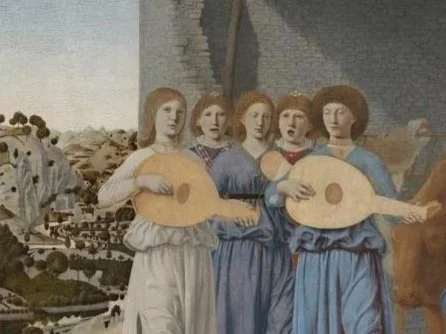
[Piero della Francesca, The Nativity [detail], National Gallery, London]
For Medtner, the preservation of this fragile structure is essential: the subsequent elements of dance and song are already coded within the sonata, and if the overarching line is not kept in tension, the entire opus risks fracture. Listeners considering the opus as a whole will notice the care Medtner takes to ensure each piece is caught within the flare of the previous, with the seams of Canzona Serenata, Danza Silvestra, and Alla Reminiscenza threaded together by single, uninterrupted notes, leaving no gap in sound.
The architecture of Op. 38 is a masterclass in Goethean Urphänomen—the idea that behind every fleeting melody lies a timeless, archetypal source—and as such, the individual pieces are not diverging miniatures but metamorphic variations of a single cell, smoothly transitioning between each other. This careful synthesis ultimately reveals itself in the Alla Reminiscenza. As the cycle traverses the elemental territories of the Danzas and Canzonas, the initial portal transforms. However, is it now facing the future or the past? Here, Medtner employs his most characteristic signature: a flight through a radiant acoustic wave that gently fades into a crystalline chord, rendering silence not as an absence of sound but as pure harmony—a hidden A Major revealed by time, to be held as long as possible.
Sergei Rachmaninov: Études-Tableaux Op. 39
If Medtner is the Renaissance Architect, Rachmaninov is the Elizabethan Dramatist. The Études-Tableaux distill plot into the intensity of character, summoning an Antaean strength from the earth. Rachmaninoff is challenging us not just to hear the music, but to imagine it through the holistic tradition of the Russian Образ (Obraz)—the symbolic portrayal that transcends description. This is music as Стихия (stikhiya): an unrestrained force that is as much a part of the Russian soul as it is of the Russian landscape.
However, this power is juxtaposed with interiority. Rachmaninov writes: ‘When I speak of a pull to earth … there is a kind of yearning for stillness, for silence, to be in awe of nature among which one lives, and partly a longing for isolation, for solitude.’ Here, the leitmotif of the 'path' is not a journey, but reconciliation. It is the irony of Rachmaninoff’s home, Ivanovka: ‘Do I need to describe this estate? No natural beauties, to which people usually ascribe mountains, valleys, oceans, were present. It was in the steppes, and the steppe—this is the same sea, without beginning nor edge, with its aroma of earth and everything living.’
Shakespearean irony underlies the entire Op. 39. Rachmaninov was fond of quoting Schopenhauer’s exclamation: 'Music – that is, Melody – and words thereto – ah, that is the whole world!' However, in these Études-Tableaux, we encounter the complete opposite: the melody is often obscured, fractured, buried. The cycle opens with immediate unease in the 1st Étude. From the first measure, something is fundamentally wrong: the C-minor tonality is lost in the rootless, restless Allegro Agitato.
The 2nd Étude is protean, the first encounter with the program’s harmonic pillar of A. If one follows the notated slurs precisely, the right-hand phrases keep changing their guise against the metric detachment of the left hand. They are absurd—these are voices talking past each other, trapped in the stagnant air of Chekhov’s Seagull. Pressure escalates, unable to find an outlet. Rachmaninoff chooses to end the piece with an inversion of Medtner’s signature: a muted, pianissimo wave that condenses the Lento Assai into a sole A-minor triad.
If there is a ghost of Medtner here, it is in the 3rd Étude, which takes the F-sharp minor of the Danza Silvestra and ignites a peripeteia marked Allegro Molto, swaying between two and three beats per measure. The irregular dance continues in the 4th Étude, a B-minor Allegro Assai that bears no time signature. We have suddenly stepped among the pastels of Degas and are among dancers. They keep poise, but the absence of a clear rhythmic anchor leaves them perpetually on pointe until the final, dignified pirouette of the coda.
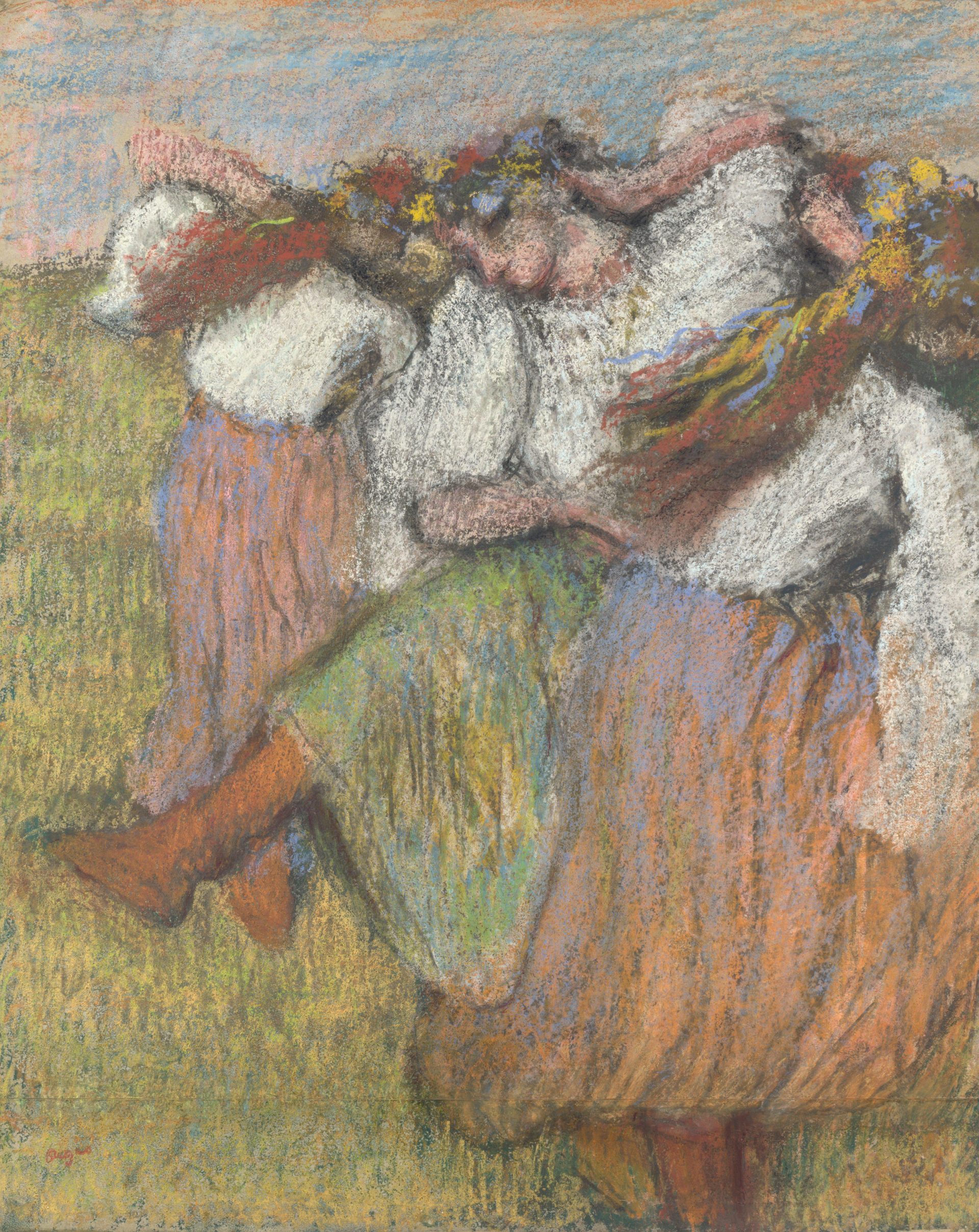
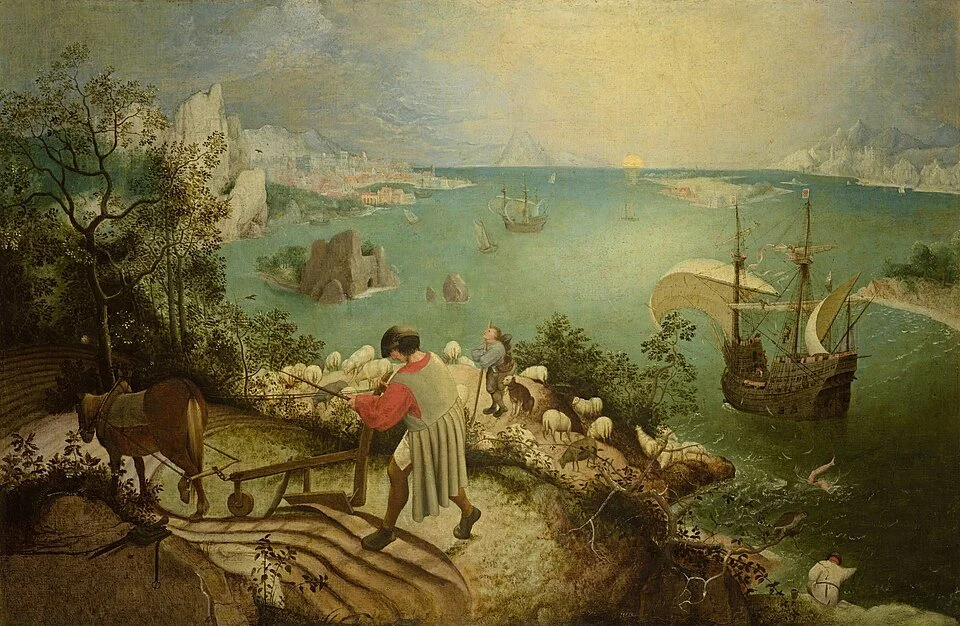
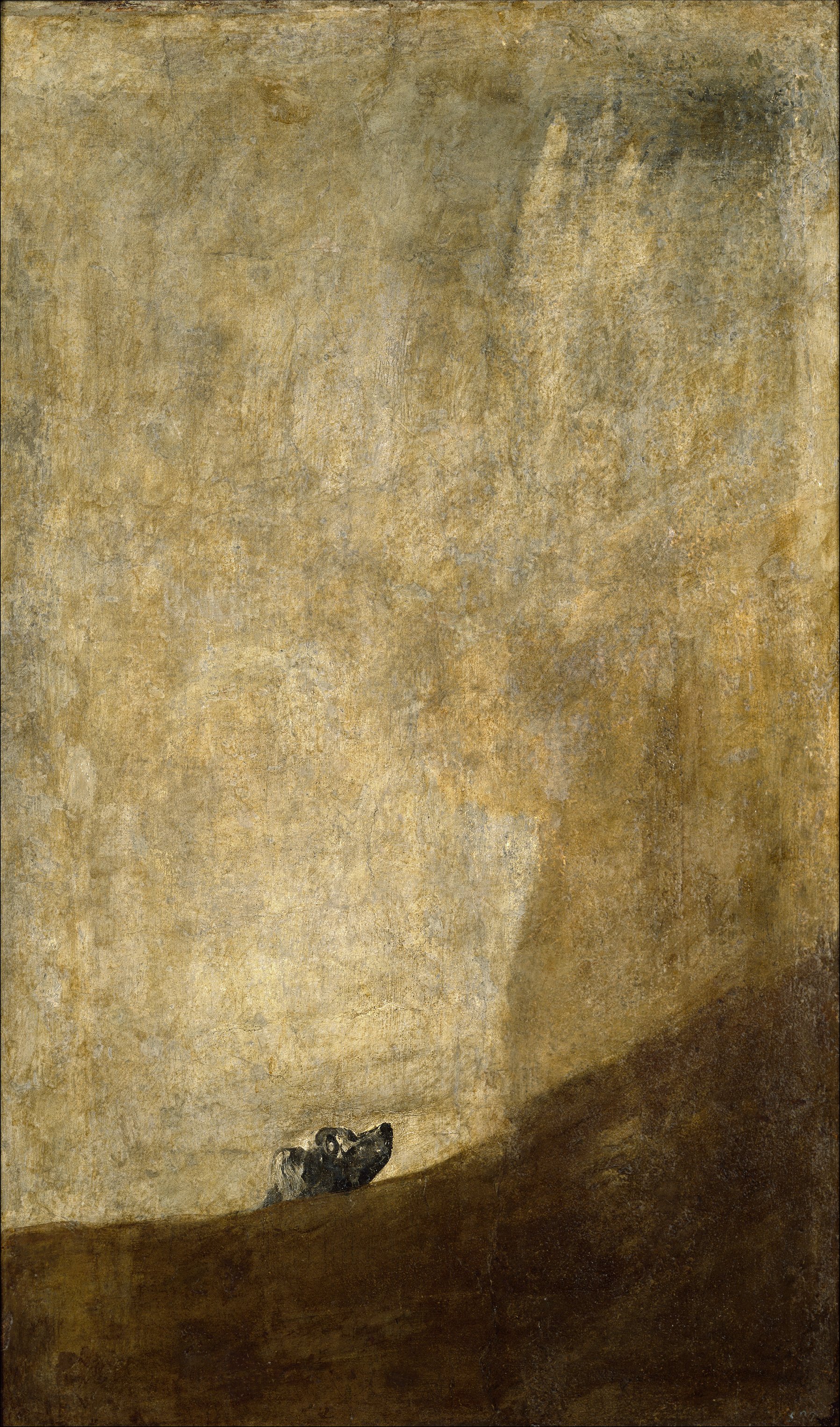
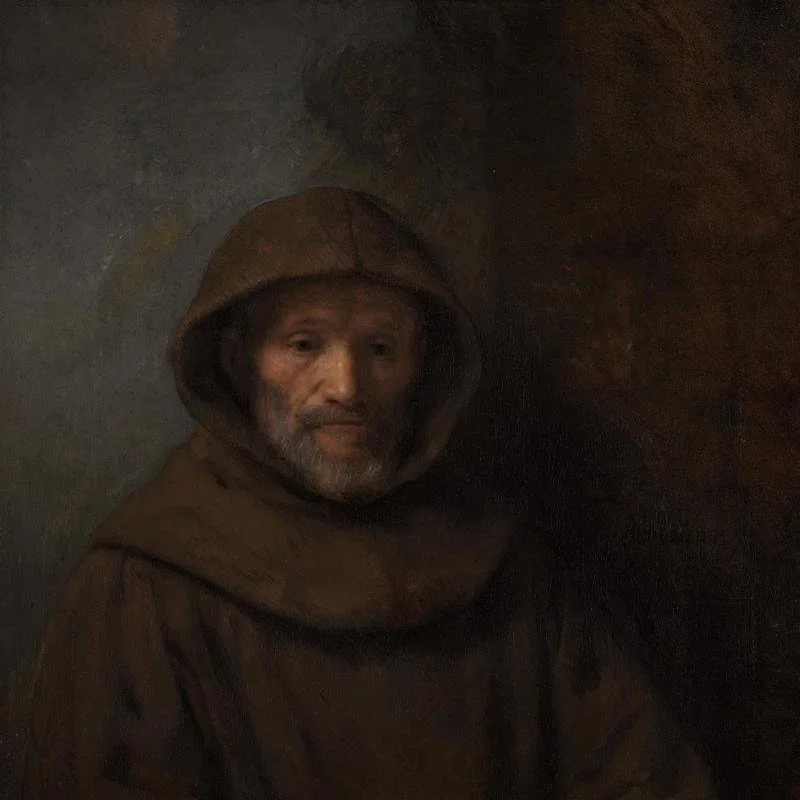
[selected images: Degas - Ukrainian Dancers, National Gallery, London | Brueghel - Fall of Icarus, Royal Museum of Fine Arts, Belgium | Goya - Drowning Dog, Prado, Madrid | Rembrandt - Franciscan Monk, National Gallery, London]
The 5th Étude possesses qualities of a summit. A single note—E-flat—launches a sweeping melody at last: a sole, Turneresque brushstroke flying through a multi-terraced fabric of harmony. However, something is missing. Where are the slurs Rachmaninov notates so carefully everywhere else? The opening of the Appassionato omits them entirely, presenting a vocal rather than tactile challenge: a melody of twenty-five measures requiring an endless depth of breath, developing onward to the first triple forte of Op. 39, and eventually receding to the solitude of the same single note—E-flat—from where it all began.
While the Appassionato may appear as an all-consuming peak, the 6th Étude does not allow repose, plunging instead toward the true core of the collection. Earlier drafts reveal an Étude revised at least four times, and first imagined alongside the earlier Op. 33. Placed here, this concise A-minor Allegro recalibrates the dramaturgy of the entire Op. 39 in the manner of the overlooked detail at the edge of Brueghel’s Fall of Icarus. Folk-tale redemption is replaced by a predatory theme that intertwines two characters. Thus, here is the gravitational heart of the program: a dark mirror to Medtner’s A-major silence, a piece of desolation on the scale of Goya’s Drowning Dog. A single pizzicato flashes in the final bar. It is too late: the tragedy occurred while we were looking elsewhere.
The subsequent Lento moves toward the spiritual. The six ritualistic invocations of the 7th Étude echo Rachmaninoff’s own clues: “funeral march … choral singing …” before “a shower of rain … fine, incessant and forlorn.” However, we should not accept Rachmaninov’s Edwardian restraint at face value. These images unfold behind the eyes of a weathered soul, trapped in a Rembrandt frame, awaiting a blazing light to soar through the cathedral.
This search uncovers an aesthetic parallel with the work of Caspar David Friedrich. In describing his Abbey in the Oakwood, Friedrich alludes to the following:
I am working on a large painting in which I am trying to portray the secret of the grave and of the future—that which is to be seen and recognized only in belief, and which will internally remain a mystery to the finite knowledge of man. Even to me, what I want to portray and how I want to portray it remains a puzzle.
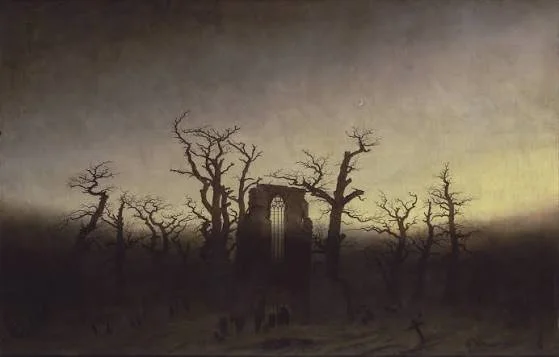
[Caspar David Friedrich - Abbey in the Oakwood. Alte Nationalgalerie, Berlin]
The mystery of the hereafter permeates the 8th Étude, the first of the concluding Allegro Moderato pair in Rachmaninov’s signature key of D. Close examination of the manuscript reveals ghost voices in measures 14–18, absent from most printed editions. Here, the music carries with the wind before the rise of the 9th Étude, a battle of F-sharp and F-natural—a single half step torn between a syncopated meter. Tempo changes are intentionally absent. The relentless drive is governed by a strict l’istesso tempo that refuses to yield, culminating in the votive octaves that foreshadow the defiant timpani of the Symphonic Dances of the future.
Memory [kind of a]
Every recording is but a snapshot, as are these notes. If the above descriptions have been useful in stirring unexpected avenues of thought, it is essential to underline that these opuses are not ‘program’ music. The guiding factor is a hope of natural expression rather than a sentiment or story. In his book, The Muse and the Fashion, Medtner explains Goethe: ‘only in self-limitation can the master be recognized … take warning and impose limitations.’ In this music, the color of intent seldom correlates with physical response on the instrument.
To interpret these cycles means to grapple with a contradictory philosophy of the keyboard. On the one hand, both Medtner and Rachmaninov were superb pianists, and their writing displays an extraordinary understanding of the instrument. On the other hand, to touch the core of this music, one cannot think like a pianist. Both composers involve sound and time in an entirely new way. To grasp these effects, Medtner invites the eyes of an architect, preserving the rhythmic transparency of the whole; Rachmaninov summons the ears of both a symphonic and choral conductor, orchestrating and guiding each voice individually.
As performers, we are not armed with the imagination that connects pen and paper at the point of origin. The composer has the greater gift. However, memory is a curious thing. To reverse earlier words, if one cannot write a melody, one must bring the whole world to it. While interpreters may not immediately access the creative faculty, through patience and research, and in the hope of evading timeworn dogma, we may cease trying to possess music precisely. If we are fortunate, it steps in front and begins to possess us, evolving into something living.
I am at the Library of Congress. A deafening silence has descended upon Washington; the city is completely snowed in. I have escaped the tyranny of the digital screen and here I am, alone, amongst things. One day they are labelled relics, the next they are revelations. I am intruding on collective memory without the promise of a response. Here is Rachmaninov’s desk. I remember the words of Arseny Tarkovsky: ‘Where is the Isle of the Dead in a decadent frame?’ I remember Goethe: ‘what we possess, we see as in the distance, while that which has vanished becomes our reality.’ I remember Buñuel: ‘I’m lucky to have spent my childhood in the Middle Ages, or, as Huysmans described it, that “painful and exquisite” epoch—painful in terms of its material aspects perhaps, but exquisite in its spiritual life. What a contrast to the world of today!’
I find the reference I am looking for. Box 71, Novyĭ Zhurnal, No. 91, 1968:
When I speak of a pull to earth, do not think that in this feeling I assume a love toward acquisition—the feeling, best expressed by Tolstoy’s story of the horse Kholstomer, that describes people’s need to call as many things as possible their “own”. No, in the thoughts of Russian people about earth there is a kind of yearning for stillness, for silence, to be in awe of nature among which one lives, and partly a longing for isolation, for solitude. I believe that in every Russian person there is something from a hermit. The reason I started to speak of this longing toward earth, is because I myself have it.
It is time to go. I leave these traces to be mottled by history, knowing their essence will remain intact. The vanishing point remains exactly where the masters have left it.